
Better Understanding Human Interaction in order to Build Better Technology that Makes Human Lives Better
The ArticuLab’s research focuses on the study of human interaction in social and cultural contexts as the input into computational systems that in turn help us to better understand human interaction, and to improve and support human capabilities in areas that really matter.

Son of Sara
Developing a new LLM-based Embodied Conversational Agent
As part of our work on socially capable conversational agents, we launched Son of SARA, an embodied agent designed to foster natural, effective human–agent interaction by combining rapport with task effectiveness. The project aims to equip agents with essential verbal and non-verbal interactional skills, building on our lab’s tradition of socially aware ECAs and research on human communication and collaboration. By leveraging Large Language Models and cutting-edge deep learning, we seek to enhance their naturalness, adaptability, and overall interactive capacities.

Collab
Collaborative Learning in School-Aged Children
How do children connect with each other while learning together? This project examines collaborative learning in school settings by combining brain imaging, behavioral observation, and fine-grained interaction analysis. Working directly with schools, we study pairs of children as they engage in structured collaborative problem-solving tasks. Using fNIRS hyperscanning, we simultaneously measure neural activity from both partners to examine how brain dynamics align during moments of coordination, explanation, and joint reasoning.

Conversational Grounding
Representation of Common Ground in the age of LLMs
To better understand the natural human communication and create conversational agents that adapt to us rather than forcing us to adapt to them, in this project, we work on the phenomenon of conversational grounding. Conversational grounding is the essential, yet often invisible, “glue” of human interaction. This project bridges the gap between the theoretical foundations of cognitive science and the probabilistic nature of deep learning to move beyond simple intent classification.

Interpersonality
Adaptive Personality for Intelligent Agents
Interpersonality is a collaborative research project between the Articulab in Inria Paris and the Korea Electronics Technology Institute (KETI). It investigates how personality is constructed, expressed, perceived, and adapted in human interactions, and how these processes can be computationally modeled to design socially intelligent artificial agents. To this end, we analyze small-group collaborative interactions between humans and examine how rapport is built and maintained in these settings.
Rapport in Agents
New computational models for rapport management in conversational agents
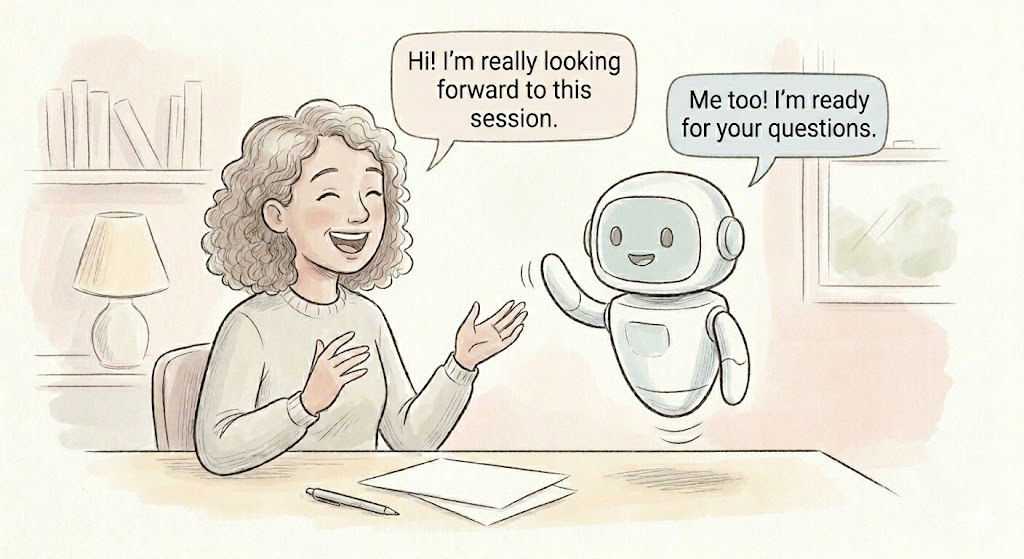
In this project, our objective is to design socially-aware conversational models that can build and maintain rapport with humans over time, as a way of improving human-agent collaboration. By integrating theories of interpersonal communication with state-of-the-art conversational models like Large Language Models, we work on exploring how virtual agents powered by these models can foster meaningful social connection while improving task outcomes, particularly in educational contexts.

RAPT
Rapport-Aligning Peer Tutor: Virtual peers building rapport to support students in learning
(Thanks to the NSF for generous funding)
The RAPT project is currently working along two fronts: developing a theory of how rapport is built, maintained, and destroyed among teens, and developing a computational architecture and system implementation that allows a virtual peer to build, maintain (and if necessary respond to destroying) rapport in the context of math tutoring.

SARA
SARA: the Socially Aware Robot Assistant
(Thanks to the Heinz Family Foundation for generous funding)
In this project, we aim to address the systematically-reduced standardized test scores of African American students compared to their Euro-American peers by using virtual peer technology to understand the role of dialect, and more broadly, cultural congruence, on students’ performance, and to help students achieve in the classroom.

Yahoo! - CMU InMind
Rapport-Building Personal Assistant on Mobile Devices
(Thanks to the Yahoo InMind project for generous funding)
The Articulab is now a part of the agreement between Yahoo! and CMU, called InMind project, where we’re trying to innovate the next next next generation of personal assistant agent.

Yahoo! - CMU InMind
Rapport-Building Personal Assistant on Mobile Devices
(Thanks to the Yahoo InMind project for generous funding)
The Articulab is now a part of the agreement between Yahoo! and CMU, called InMind project, where we’re trying to innovate the next next next generation of personal assistant agent.

Alex
Scaffolding Science Achievement in a Culturally Diverse Classroom: Bridging the Gap with Virtual Peers
(Thanks to the Heinz Family Foundation for generous funding)
In this project, we aim to address the systematically-reduced standardized test scores of African American students compared to their Euro-American peers by using virtual peer technology to understand the role of dialect, and more broadly, cultural congruence, on students’ performance, and to help students achieve in the classroom.