
Collab
Collaborative Learning in School-Aged Children
How do children connect with each other while learning together? This project examines collaborative learning in school settings by combining brain imaging, behavioral observation, and fine-grained interaction analysis. Working directly with schools, we study pairs of children as they engage in structured collaborative problem-solving tasks.
Using fNIRS hyperscanning, we simultaneously measure neural activity from both partners to examine how brain dynamics align during moments of coordination, explanation, and joint reasoning. These neural measures are integrated with detailed analyses of dialogue, task performance, and interactional structure, allowing us to link learning-relevant behaviors with underlying neural processes. By capturing collaboration across neural, behavioral, and interactional levels, the project examines how collaborative processes unfold in real time and how they support effective learning, with implications for developmental and learning science and the design of educational technologies and socially aware AI systems.
Overview
This project investigates collaborative learning as a dynamic, multilevel process that unfolds through interaction, behavior, and neural activity. Working in close partnership with schools in France, we study pairs of children as they engage in structured collaborative problem-solving tasks across multiple sessions. This longitudinal, multimodal approach allows us to link moment-to-moment interactional processes with learning outcomes and neural synchrony, providing a richer understanding of how effective collaboration supports learning in school-aged children.
Children (and a cohort of adults) participate in a series of age-appropriate scientific reasoning tasks that involve both individual work and peer collaboration, as well as periods of informal conversation. These tasks are designed to elicit explanation, coordination, and joint reasoning, key components of collaborative learning. Data is collected in dedicated testing spaces within schools or affiliated education or after-school settings, preserving ecological validity while ensuring high-quality, synchronized recordings of the behavioral and neural activity of the two participants..
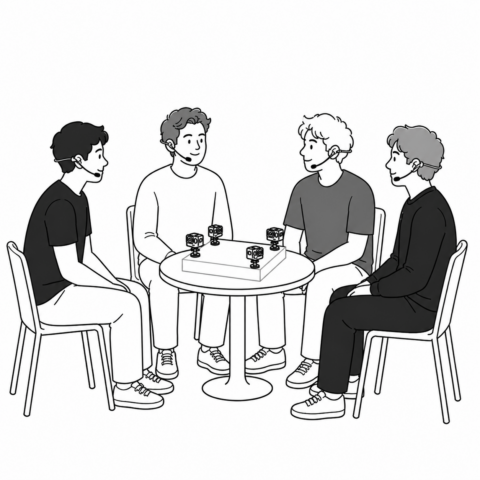
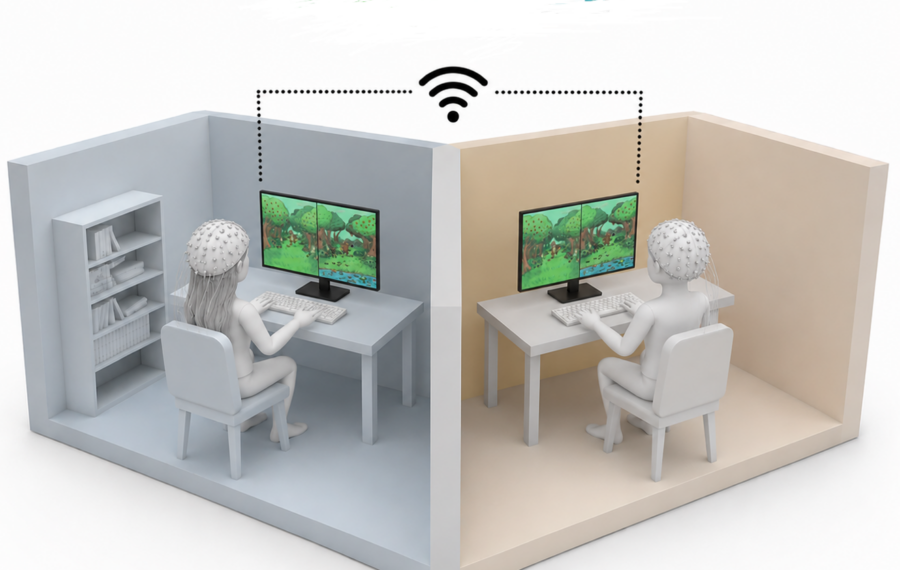
A central feature of the project is its multimodal approach. Using functional near-infrared spectroscopy (fNIRS) hyperscanning, we simultaneously record brain activity from both members of a dyad while they collaborate, enabling us to examine inter-brain synchrony during learning-relevant interaction. These neural measures are tightly aligned with detailed analyses of language, vocal characteristics (such as prosody and speech rhythm), and non-verbal behavior (including gaze, gesture, and facial expression), as well as with objective measures of task performance and learning gains. Integrating these data streams allows us to examine how moment-to-moment interactional dynamics relate to patterns of neural coordination, and to identify the combinations of behaviors and neural processes that characterize productive collaboration.
By linking brain synchrony with interactional structure and learning outcomes, the project moves beyond single-modality accounts and provides a comprehensive picture of how collaborative learning unfolds across neural, behavioral, and performance levels.
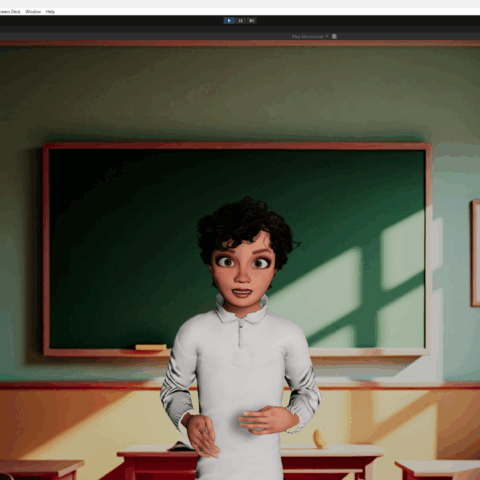
Thus, this work conceptualizes collaboration as an emergent property of the dyad, shaped by reciprocal adaptation between partners. The findings contribute to developmental cognitive neuroscience, educational research, and human-centered AI, providing empirically grounded insights into how collaborative learning works, and how it might be better supported through educational technologies and AI systems such as “virtual peers” <RAPT> that can collaborate with children in developmentally appropriate ways, agents that are sensitive to interactional cues, adapt to their human partners, and support learning through effective collaboration.
Motivation
Children frequently learn through collaboration, yet working with peers does not automatically lead to better learning. While some interactions support shared reasoning and sustained engagement, others break down or fail. Identifying what makes collaboration effective, and how those processes unfold over time, remains a central challenge for developmental and educational research.
Much of what we know about collaborative learning comes from studies that focus on a single level of analysis, such as observable behavior or individual cognitive outcomes. This leaves critical gaps in our understanding of how partners adapt to one another during interaction, how coordination emerges moment by moment, and how these interactional processes relate to underlying neural activity. In particular, the role of inter-brain dynamics during collaborative learning in childhood is still poorly understood.s. There is a large body of research aiming at improving conversational agents in dyadic settings. This focus often overlooks the intricate, multi-layered structure of group dynamics, where rapport is not merely the sum of its individual parts but a collective perception influenced by the group’s composition and context. Group settings introduce additional complexity: rapport emerges not only through dyadic relationships within the group but also is influenced by group-level perceptions, and the group composition itself influences how rapport is built within it.
Methodology
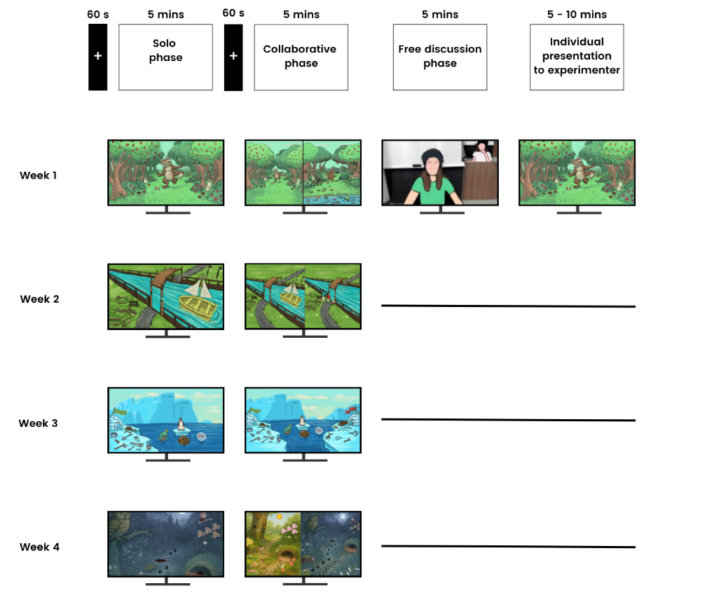
The project adopts a longitudinal, multimodal design to capture collaborative learning as it unfolds over time. Pairs of children aged 5-6, 8-9, and 11-12 (as well as a cohort of adults) participate in a series of six weekly sessions, including one week of pretest, four weeks of tasks, and one week of post-test. During the four weeks of tasks, they complete fun and engaging structured scientific reasoning exercises both individually and collaboratively. Tasks are designed to elicit explanation, hypothesis generation, and evidence-based reasoning (eg, analyzing images of physical systems such as bridges or ramps), and are repeated across sessions to track change and learning over time.
Each session follows a consistent structure. Children first work individually on the task, generating hypotheses and explanations on their own. They then collaborate with a same-age peer via video-conference to refine their ideas together, followed by a short period of informal conversation. This design allows us to compare individual reasoning with collaborative processes, as well as to examine how task-focused interaction and free social interaction contribute to learning and coordination.
During collaboration, we collect synchronized neural, behavioral, and interactional data. A subset of child dyads is hyperscanned using functional near-infrared spectroscopy (fNIRS), which allows for the simultaneous, non-invasive recording of brain activity from both children while they interact virtually via webex. This enables the examination of inter-brain synchrony during their interaction, particularly in brain regions involved in social cognition and coordination, such as temporo-parietal junction (TPJ).
In parallel, high-quality audio and video recordings capture verbal language, vocal features (such as intonation, speech rate, and rhythm), and non-verbal behaviors including gaze, facial expressions, head movements, and gestures. These data are analyzed using a combination of automated feature extraction tools and human annotation, allowing for fine-grained, time-aligned measures of interactional dynamics. Learning outcomes are assessed using pre- and post-tests that measure gains in scientific reasoning across the six-week period.
To contextualize collaborative behavior, children also complete a set of age-appropriate socio-cognitive and linguistic assessments presented as interactive games. These measures assess abilities such as theory of mind, executive function, pragmatic language, and non-verbal sensitivity, enabling us to examine how individual differences relate to collaborative processes and neural coordination.
This project is therefore motivated by the need for an integrated, process-level account of collaboration. By studying children’s interactions across repeated sessions and combining behavioral, interactional, and neural measures, we want to understand how collaboration develops, stabilizes, and changes across middle childhood. This approach provides a foundation for advancing theories of collaborative learning and for informing the design of future educational technologies such as AI-based collaborative partners.
Data Collection
Data are collected in partnership with schools in France, using dedicated testing spaces within school or after-school programs. This approach balances ecological validity with experimental control and allows the study of collaboration in environments familiar to children. Additionally, considering that the data collection is done longitudinally, going into schools for data collection helps ensure that the collaborative context remains naturalistic and consistent across timepoints, preserving the ecological validity of repeated measures.
References
Bonnaire J, Dumas G and Cassell J (2024) Bringing together multimodal and multilevel approaches to study the emergence of social bonds between children and improve social AI. Front. Neuroergon. 5:1290256. doi: 10.3389/fnrgo.2024.1290256