
Interpersonality
Adaptive Personality for Intelligent Agents
Overview
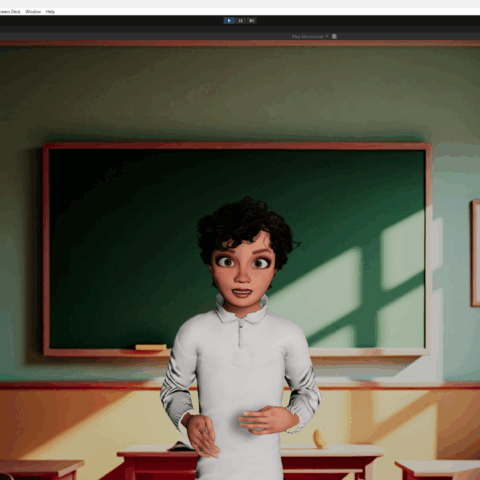
Launched in 2023, Interpersonality is a collaborative research project between the Articulab in Inria Paris and the Korea Electronics Technology Institute (KETI). It investigates how personality is constructed, expressed, perceived, and adapted in human interactions, and how these processes can be computationally modeled to design socially intelligent artificial agents. To this end, we analyze small-group collaborative interactions between humans and examine how rapport is built and maintained in these settings.
The project moves beyond static trait representations of personality. Instead, it treats personality as dynamic, relational, and context-sensitive, shaped by interpersonal processes and moderated by social factors such as gender and cultural background. One of our particular interests is how the phenomenon of rapport is affected by personality traits.
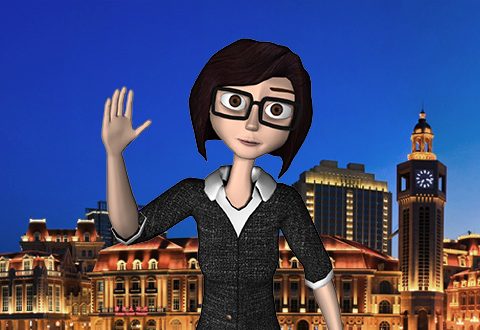
Our goal is to develop adaptive personality models for intelligent agents that can participate meaningfully in human social interaction, in particular in group settings.
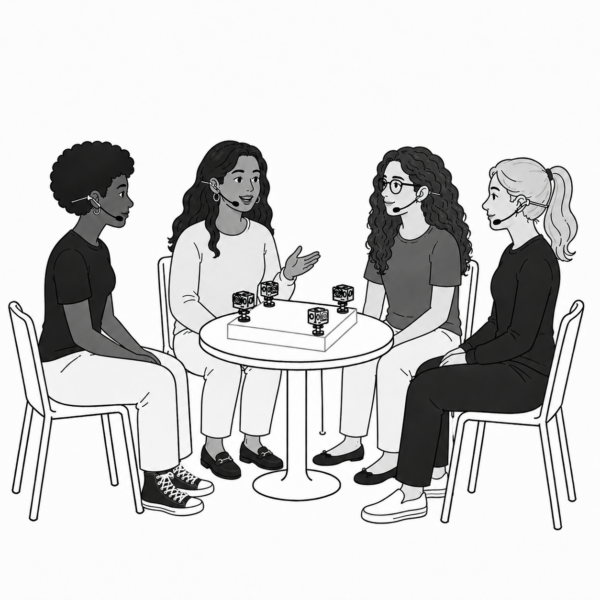
Interpersonal Factors
A key contribution of the project is analyzing how interpersonal and demographic factors influence personality expression and perception. We are interested in how cultural background modulates acceptable relational behavior and how personality attribution develops over conversation, without prior knowledge of social status among people. These insights guide the development of AI systems that are socially and culturally aware, avoiding one-size-fits-all personality models.
Designing Adaptive Intelligent Agents
The project aims to translate theoretical and empirical findings into agent architectures capable of:
- Modulating communicative style
- Adapting to user characteristics
- Responding appropriately across cultural contexts
- Navigating group dynamics
The aim is not simply more expressive agents, but agents capable of creating and maintaining rapport with their users. There is a large body of research aiming at improving conversational agents in dyadic settings. This focus often overlooks the intricate, multi-layered structure of group dynamics, where rapport is not merely the sum of its individual parts but a collective perception influenced by the group’s composition and context. Group settings introduce additional complexity: rapport emerges not only through dyadic relationships within the group but also is influenced by group-level perceptions, and the group composition itself influences how rapport is built within it.
Data Collection
A key component of a comparative cross-cultural analysis of how conversation is affected by groupings of different personalities, and the impact of these mixtures of personality on rapport between the interlocutors and the effectiveness of their conversation, among other conversational phenomena. Our aim is to first observe how rapport is constructed between people who encounter each other for the first time and build a relationship, and use this knowledge to inform Embodied Conversational Agents.
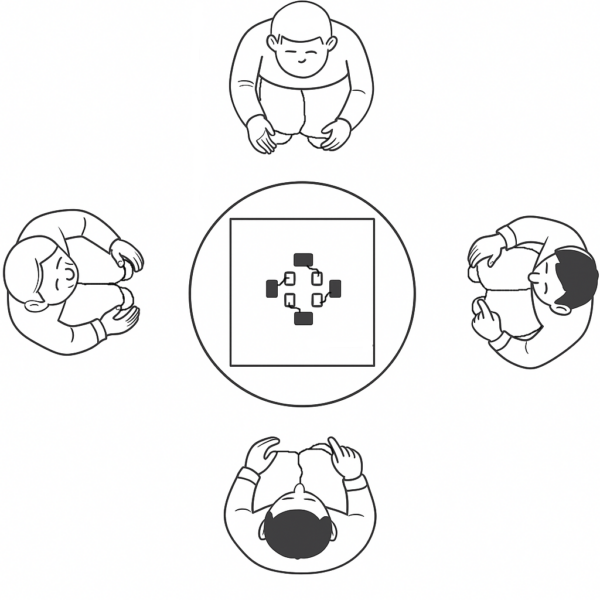
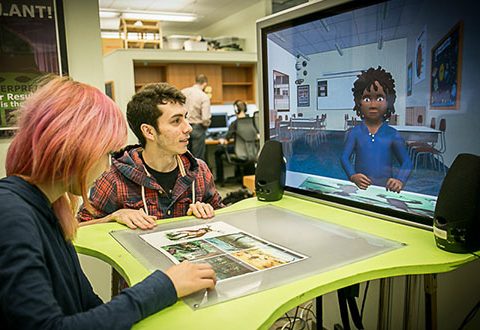
Interpersonality Corpus collection set-up
We therefore designed a corpus that consists of a series of groups of four participants having open discussions on predefined subjects, designed to allow even strangers to converse freely while maintaining privacy. The whole procedure and forms have been approved by Inria’s Internal Review Board (IRB) to ensure ethical standards are met.
References
Ahmad, R., Siemon, D., Gnewuch, U., & Robra-Bissantz, S. (2022). A Framework of Personality Cues for Conversational Agents. In Proceedings of the 55th Hawaii International Conference on System Sciences.
Ball, G., & Breese, J. (2000). Emotion and Personality in a Conversational Agent. In Cassell et al. (Eds.), Embodied Conversational Agents. MIT Press.
Cafaro, A., Vilhjálmsson, H. H., Bickmore, T., Heylen, D., Jóhannsdóttir, K. R., & Valgarðsson, G. S. (2012). First Impressions: Users’ Judgments of Virtual Agents’ Personality and Interpersonal Attitude in First Encounters. In Y. Nakano, M. Neff, A. Paiva, & M. Walker (Eds.), Intelligent Virtual Agents (Vol. 7502, pp. 67–80). Springer Berlin Heidelberg.
Celiktutan, O., & Gunes, H. (2015). Computational analysis of human-robot interactions through first-person vision: Personality and interaction experience. 2015 24th IEEE International Symposium on Robot and Human Interactive Communication (RO-MAN), 815820. https://ieeexplore.ieee.org/abstract/document/7333602/
Cerekovic, A., Aran, O., & Gatica-Perez, D. (2016). Rapport with virtual agents: What do human social cues and personality explain? IEEE Transactions on Affective Computing, 8(3), 382–395.
Costa Jr, Paul T., and Robert R. McCrae. (2008). The Revised Neo Personality Inventory (Neo-Pi-r). Sage Publications, Inc.
Jain, M., Kumar, P., & Cassell, J. (2018). Predicting Rapport in Small Group Interactions using Multimodal Features. Proceedings of the 20th ACM International Conference on Multimodal Interaction (ICMI)
Jiang, G., Xu, M., Zhu, S.-C., Han, W., Zhang, C., & Zhu, Y. (2023). Evaluating and inducing personality in pre-trained language models. In Thirty-seventh Conference on Neural Information Processing Systems (NeurIps).
Maples-Keller, J. L, Williamson, R. L., Sleep, C. E., Carter, N. T., Campbell, W. K., & Miller, J. D. (2019). Using item response theory to develop a 60-item representation of the NEO PI–R using the International Personality Item Pool: Development of the IPIP–NEO–60. Journal of Personality Assessment, 101, 4-5. DOI: 10.1080/00223891.2017.1381968
Hanna, N., & Richards, D. (2015). In the Agent we Trust! The Role of Personality and Cognition in Human Trust in Virtual Agents. Fourth International Workshop on Human-Agent Interaction Design and Models (HADIM 2015).
Nalini Ambady and Robert Rosenthal. 1992. Thin slices of expressive behavior as predictors of interpersonal consequences: A meta-analysis. Psychological Bulletin 111, 2 (1992), 256.
Ishii, R., Ahuja, C., Nakano, Y. I., & Morency, L.-P. (2020). Impact of Personality on Nonverbal Behavior Generation. Proceedings of the 20th ACM International Conference on Intelligent Virtual Agents, 1–8. https://doi.org/10.1145/3383652.3423908
Perugia, G., Paetzel, M., & Castellano, G. (2020). On the Role of Personality and Empathy in Human-Human, Human-Agent, and Human-Robot Mimicry. In A. R. Wagner, D. FeilSeifer, K. S. Haring, S. Rossi, T. Williams, H. He, & S. Sam Ge (Eds.), Social Robotics (Vol. 12483, pp. 120–131). Springer International Publishing. https://doi.org/10.1007/978-3-03062056-1_11
Schwartz, H. A., et al. (2023). Personality Traits in Large Language Models. arXiv preprint arXiv:2307.00184. https://arxiv.org/abs/2307.0018
Spencer-Oatey, Helen, 2002. Managing rapport in talk: using rapport sensitive incidents to explore the motivational concerns underlying the management of relations. Journal of Pragmatics 34, 529–545.